Minnesota's Top Attractions
From world-record shopping complexes and acclaimed theaters to living history museums and beloved annual fairs — Minnesota's attractions are as diverse as the state itself.
A State Full of Extraordinary Experiences
Minnesota consistently delivers travel experiences that surprise, delight, and linger long after you've returned home. Here is the definitive guide to the state's most compelling attractions.
When most people think of travel destinations, Minnesota rarely tops the list. That is precisely what makes it such a spectacular surprise. This state has been quietly accumulating world-class attractions for well over a century — an art museum whose permanent collection ranks among the finest in the nation, a theater with no equal in the American regional scene, a shopping complex so vast it houses an indoor amusement park and an aquarium, a state fair so legendary it has been feeding and entertaining Minnesotans for over 150 years. Add to these the natural wonders of the North Shore, the Boundary Waters, and 66 state parks, and you have a travel destination of extraordinary depth and variety.
What unifies these disparate attractions is a distinctly Minnesotan quality — a commitment to doing things well, investing in public spaces, and creating experiences that feel genuinely meaningful rather than commercially cynical. Minnesota spends more per capita on arts funding than almost any other U.S. state. Its museums are affordable and accessible. Its public parks are impeccably maintained. Even the Mall of America, seemingly the most commercial of destinations, has become a genuine community gathering place that tells the story of American consumer culture at its most ambitious and audacious.
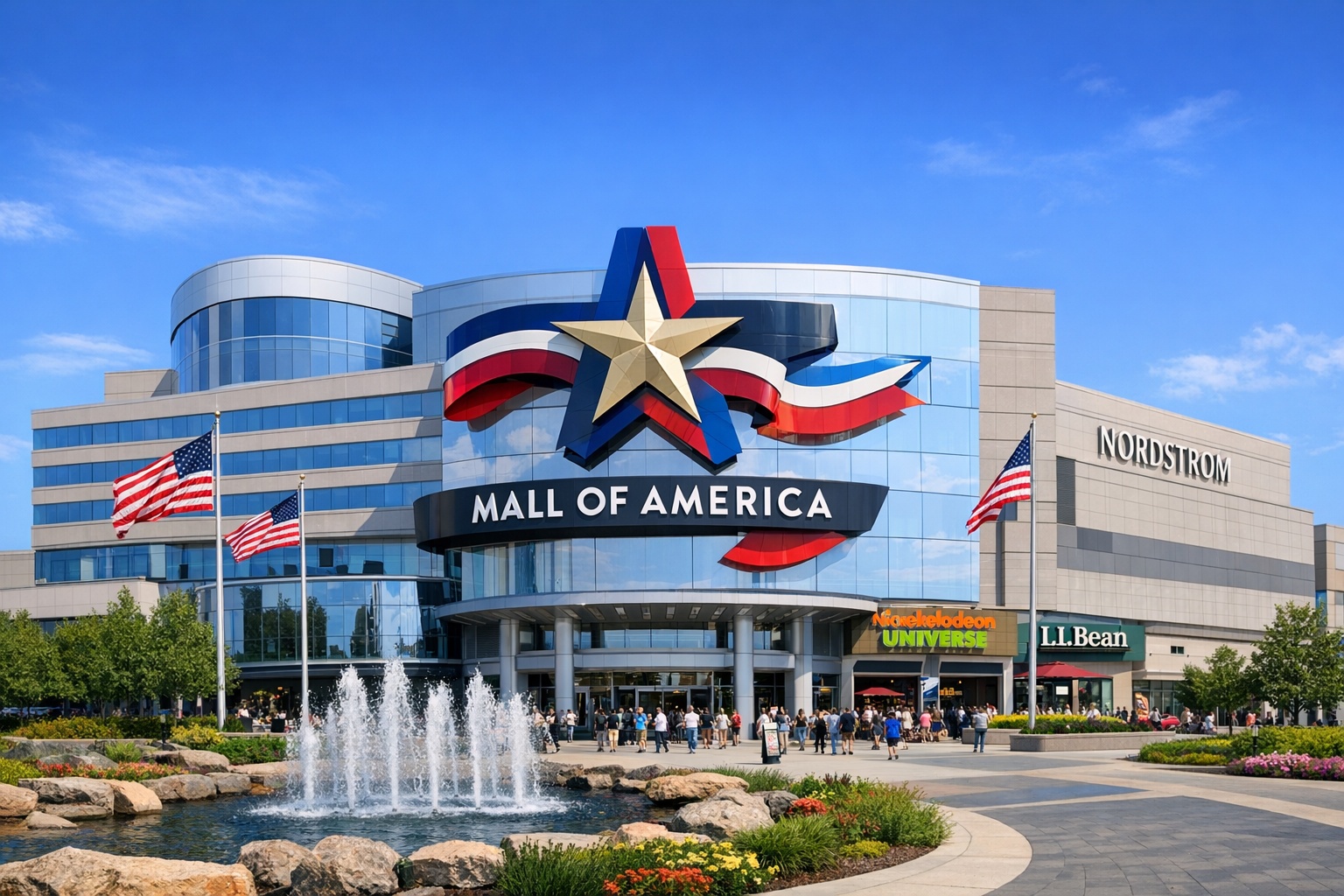
Mall of America — An American Icon
No single attraction in Minnesota receives more visitors annually than the Mall of America in Bloomington, just south of Minneapolis near the airport. Opened in August 1992, this retail and entertainment colossus has since become one of the most visited destinations in the entire United States, attracting between 40 and 44 million visitors per year — more than the total annual visitation to Disney World, Yellowstone, and the Grand Canyon combined.
The numbers associated with Mall of America are simply staggering. The complex covers 5.6 million square feet of total floor space, encompassing over 520 retail stores, more than 50 restaurants and food court vendors, two hotels, a 14-screen movie theater, a comedy club, a spa and salon, and an 18-hole miniature golf course. At its heart sits Nickelodeon Universe, a fully themed indoor amusement park spanning over 7 acres and featuring 27 rides including a full-sized roller coaster that soars through the mall's central atrium. The mall also houses Sea Life Minnesota Aquarium, where visitors walk through a 300-foot underwater tunnel surrounded by sharks, rays, sea turtles, and thousands of other marine species.
Despite its scale, the Mall of America manages to feel human-scaled and genuinely enjoyable. The building is organized into four wings radiating from the central Nickelodeon Universe park, and natural light floods the structure through massive skylights. During Minnesota's long winters, the mall provides a welcome subtropical microclimate — it maintains comfortable temperatures without a central heating system, sustained entirely by the body heat of visitors and the lighting systems.
🛒 Mall of America Facts
The mall contains enough concrete to build an 88-story building. It hosts 12,000+ events per year and generates $2 billion in annual economic impact for Minnesota.
Beyond shopping, the Mall of America has evolved into a genuine cultural institution. It hosts over 12,000 events annually, from fashion shows and celebrity appearances to school science fairs and charity fundraisers. The mall's wedding chapel performs hundreds of ceremonies each year. Its roster of tenants extends far beyond mainstream national chains — a substantial number of shops are locally owned Minnesota businesses for whom a Mall of America storefront represents their most visible retail presence. The LEGO Store, American Girl flagship, and Crayola Experience make it an incomparable destination for families with children.

The Great Minnesota Get-Together: State Fair
Every summer, in the final 12 days straddling August and September, Minnesota undergoes a transformation. The Minnesota State Fair — affectionately known as "The Great Minnesota Get-Together" — takes over the 322-acre fairgrounds in Falcon Heights and becomes the de facto social hub of the entire state. With average attendance of nearly 2 million people over its run, the Minnesota State Fair is consistently ranked among the top three largest state fairs in the United States.
What makes the Minnesota State Fair so beloved is its unique combination of agricultural tradition, entertainment spectacle, and sheer gluttonous joy. The fair's food scene is legendary among culinary adventurers nationwide — a parade of deep-fried, skewered, and cream-filled creations that push the boundaries of what food can be. The iconic food on a stick tradition means that virtually anything edible at the fair has at some point been impaled on a wooden skewer: corn dogs, chocolate-covered cheesecake on a stick, walleye on a stick, deep-fried candy bars on a stick, even deep-fried butter on a stick.
The fair's agricultural heart is still very much alive. The livestock barns house championship cattle, horses, sheep, pigs, goats, and rabbits. The Creative Activities Building displays prize-winning quilts, jams, photography, and handicrafts. The Miracle of Birth Center, where newborn farm animals enter the world in front of live audiences, draws massive crowds of families throughout the day.
Entertainment at the fair is relentlessly varied. The Grandstand concert series brings nationally touring performers for nightly concerts. The free outdoor Leinie Lodge Bandshell stage hosts local and regional acts from morning to midnight. The midway fills with carnival rides. Demonstrations, competitions, craft exhibitions, and educational exhibits fill every corner of the grounds. For Minnesotans, the State Fair is not merely an event — it is a ritual, a reunion, a seasonal rite of passage that signals the approaching end of summer and is anticipated with genuine emotion throughout the year.
World-Class Arts in the Heart of the Midwest
Minnesota's arts scene is world-renowned — from the Minneapolis Institute of Art to the legendary Guthrie Theater on the Mississippi River.

Minneapolis Institute of Art (Mia)
The Minneapolis Institute of Art, universally known as Mia, is one of the finest encyclopedic art museums in the United States. Founded in 1883 and housed in a magnificent Beaux-Arts building designed by McKim, Mead & White — with a later modern addition by Kenzo Tange — Mia's permanent collection spans 5,000 years of human creativity across 90,000 works of art from nearly every culture and period in history.
The breadth of Mia's holdings is remarkable. The Asian Art galleries contain one of the finest collections of Chinese, Japanese, Korean, and South and Southeast Asian art in North America. The European painting galleries hold masterworks by Rembrandt, El Greco, and a stunning array of Dutch Golden Age masters. The American galleries trace the arc of American artistic identity from colonial portraiture through Abstract Expressionism.
Mia is free to visit for general admission — one of the largest free-admission encyclopedic art museums in the world. This policy reflects the museum's deep commitment to being a genuinely accessible public institution. Only special ticketed exhibitions carry an admission fee. The museum attracts approximately 700,000 visitors annually and hosts over 1,000 public programs each year.
🎨 Mia Highlights
Look out for the Puvis de Chavannes murals in the stairwell, the 2,000-year-old Cambodian Torso of a Deity, and the breathtaking lacquer room from the Yun Gang Palace in China — one of only six imperial lacquer rooms outside China.
The Guthrie Theater
Opened on its current Mississippi riverfront site in 2006, the Guthrie Theater is one of the most important regional theater companies in the English-speaking world. Founded in 1963 by British director Tyrone Guthrie specifically to create a theatrical alternative to Broadway's commercially driven model, the Guthrie has spent six decades building an artistic legacy that rivals the best theaters anywhere on earth. The current building — a striking deep blue cantilevered structure designed by French architect Jean Nouvel — contains three performance spaces: the flagship 1,100-seat Wurtele Thrust Stage, the 700-seat McGuire Proscenium Stage, and the intimate 200-seat Dowling Studio for new and experimental works. The theater's famous Endless Bridge cantilevered overlook extends 178 feet over the Mississippi River, offering one of the most dramatic urban views in Minneapolis.
Walker Art Center
The Walker Art Center in Minneapolis is one of the premier contemporary art museums in the world, internationally recognized for its cutting-edge permanent collection, ambitious exhibition programming, and deep engagement with performance, film, and design. Adjacent to the Walker is the Minneapolis Sculpture Garden — free and open year-round — a seven-acre public green space featuring over 40 sculptures including the iconic Spoonbridge and Cherry by Claes Oldenburg and Coosje van Bruggen, the unofficial symbol of Minneapolis arts culture.
Science Museum of Minnesota
Located on the banks of the Mississippi River in downtown Saint Paul, the Science Museum of Minnesota is one of the finest science museums in the United States and a perennial favorite with families. With over 1.6 million visitors annually, the museum's permanent galleries cover everything from the Human Body to Dinosaurs & Fossils to Collections showcasing over 1.7 million natural history objects. The museum's IMAX Dome Theater, with a screen over six stories high, is one of the most impressive in the region.
Historic Fort Snelling
Perched on a dramatic bluff at the confluence of the Mississippi and Minnesota Rivers — a site sacred to the Dakota people as "Bdote," the center of creation — Historic Fort Snelling is one of Minnesota's most significant historical sites. Built between 1820 and 1825 as the northernmost U.S. military installation in the frontier, the restored fort has been reimagined as a site of honest, multivocal history — presenting not only the perspective of Euro-American settlers but also the stories of the Dakota people, enslaved African Americans, mixed-heritage voyageur families, and soldiers from a dozen different national backgrounds. Living history interpreters in period costume bring the early 19th century to life, demonstrating blacksmithing, cooking, and military drill.
Minneapolis: A City of Neighborhoods
Minneapolis is a city that rewards neighborhood-level exploration. Each district has its own character, dining scene, and cultural identity.
Downtown & North Loop
The heart of Minneapolis combines corporate towers with a thriving arts-and-restaurant district. The North Loop — a converted warehouse neighborhood — is now the city's hottest dining and nightlife destination, packed with acclaimed restaurants, cocktail bars, and design studios in handsome 19th-century brick buildings. First Avenue nightclub anchors the entertainment district.
Uptown & Lyn-Lake
Southwest of downtown, Uptown is Minneapolis's bohemian heart — a dense grid of independent boutiques, vintage clothing shops, record stores, coffee houses, and restaurants catering to the city's young, culturally engaged population. The nearby Chain of Lakes — Lakes Calhoun (Bde Maka Ska), Harriet, and Isles — provide gorgeous summer recreation just steps from the shopping streets.
Northeast Minneapolis
Known locally as "Nordeast," Northeast Minneapolis is the city's arts district, home to dozens of artist studios, galleries, and the monthly Northeast Minneapolis Art District open studio event. The neighborhood is also a food lover's paradise, with an unusually high density of acclaimed restaurants, craft breweries, and specialty food shops concentrated along Central and Johnson avenues.
Saint Paul: Minnesota's Historic Heart
Often overshadowed by its twin, Saint Paul rewards explorers with an intimate, historic character and an exceptional collection of attractions of its own.
Saint Paul, Minnesota's state capital, is frequently underappreciated by visitors who focus exclusively on Minneapolis, but those who take the time to cross the river discover a city of extraordinary charm, architectural magnificence, and cultural richness. Saint Paul's downtown is bookended by two landmarks that alone justify a visit: the Minnesota State Capitol — a breathtaking 1905 Beaux-Arts masterwork by Cass Gilbert, with the world's largest unsupported marble dome — and the Cathedral of Saint Paul, another Cass Gilbert design modeled closely on St. Peter's in Rome, whose dome dominates the city's skyline.
The Minnesota History Center in Saint Paul is the finest state history museum in America — a monumental granite building housing permanently rotating exhibitions that trace the full arc of Minnesota's human story from the earliest Indigenous inhabitants to the present day. The museum's permanent collection contains over 175,000 objects and 30,000 photographs, and its exhibitions are consistently innovative in their approach to material culture, social history, and storytelling.
The Minnesota Zoo in Apple Valley, approximately 20 miles south of Saint Paul, is one of the finest zoological institutions in North America. Unlike traditional zoos, the Minnesota Zoo organizes its exhibits around ecological biomes — the tropics, the northern forests, the Asian plains — creating immersive habitats that prioritize animal welfare and visitor education simultaneously. The zoo is home to over 4,500 animals representing nearly 500 species, including Amur tigers, snow leopards, dolphins, komodo dragons, and a vast array of bird species.
Grand Avenue, Saint Paul's most celebrated commercial street, runs for nearly two miles through the Summit Hill neighborhood, lined with Victorian commercial buildings housing an eclectic mix of locally owned boutiques, restaurants, galleries, and bars. Adjacent to Grand Avenue is the Summit Avenue Historic District — a stunning mile-long corridor of Victorian and Edwardian mansions, including the boyhood home of F. Scott Fitzgerald and the James J. Hill House, the palatial 1891 residence of the railroad magnate whose ambition essentially built the American Northwest.
🏛️ Minnesota State Capitol
The 1905 Cass Gilbert Capitol building features the world's largest unsupported marble dome and is open for free guided tours. The recent $310 million restoration returned it to its original splendor.
🦁 Minnesota Zoo
One of North America's top zoos, housing 4,500+ animals in ecological biome exhibits. The zoo also operates one of the largest wildlife conservation programs in the U.S., supporting over 100 field projects.
📚 F. Scott Fitzgerald
Saint Paul was home to F. Scott Fitzgerald, author of The Great Gatsby. His childhood home at 599 Summit Avenue is a National Historic Landmark open for seasonal tours.
Duluth & the North Shore: Minnesota's Great Escape
The 150-mile North Shore Scenic Drive along Highway 61 from Duluth to Grand Portage is widely regarded as one of the most beautiful drives in America.
Duluth, perched on a dramatic hillside above Lake Superior at the mouth of the Saint Louis River, is one of America's most underrated cities and the gateway to Minnesota's North Shore. Its setting is dramatic — streets climb precipitously from the harbor to residential neighborhoods with sweeping views over the largest freshwater lake on earth. Canal Park, the city's revitalized waterfront district, buzzes with restaurants, breweries, and galleries, while the landmark Aerial Lift Bridge — one of the most photographed structures in Minnesota — rises and falls to admit the massive ocean-going freighters that still ply the Great Lakes trade routes.
Driving north from Duluth on Highway 61, the landscape becomes increasingly dramatic. Waterfalls cascade down basalt cliffs directly onto Lake Superior's shore. The Gooseberry Falls State Park is the first — and perhaps most visited — of the North Shore's eight state parks, where the Gooseberry River drops 80 feet over three separate falls before tumbling into Superior. Further north, Tettegouche State Park encompasses rugged inland lakes, old-growth forest, and dramatic lakeshore cliffs. Near the highway's terminus at Grand Portage, Grand Portage National Monument preserves the historic fur trade depot where North West Company voyageurs once portaged their cargo between Lake Superior and the Canadian interior.
The Iron Range: Minnesota's Rugged Interior
Stretching across northeastern Minnesota between Duluth and the Canadian border, the Iron Range is one of America's most distinctive regional landscapes. The Hull-Rust-Mahoning Open Pit Mine near Hibbing is one of the largest open-pit iron ore mines in the world — 3.5 miles long, 1.5 miles wide, and 600 feet deep — and can be viewed from a dramatic overlook. Hibbing is also Bob Dylan's hometown; the local high school's auditorium is essentially a pilgrimage site for music fans. The Minnesota Discovery Center in Chisholm offers an outstanding survey of the region's immigrant heritage, labor history, and mining technology.
Minnesota Attractions at a Glance
| Attraction | Location | Category | Admission |
|---|---|---|---|
| Mall of America | Bloomington | Shopping & Entertainment | Free (rides/aquarium paid) |
| Minneapolis Institute of Art | Minneapolis | Art Museum | Free general admission |
| Walker Art Center | Minneapolis | Contemporary Art | $15 (garden free) |
| Guthrie Theater | Minneapolis | Theater | Varies by show |
| Science Museum of Minnesota | Saint Paul | Science & Education | $15–$20 |
| Minnesota History Center | Saint Paul | History Museum | $12 adults, free for children |
| Minnesota Zoo | Apple Valley | Zoo & Conservation | $22 adults, $16 children |
| Historic Fort Snelling | Saint Paul/Minneapolis | Living History | $12 adults |
| Minnesota State Fair | Falcon Heights | Annual Fair | $17 adults (late Aug–Sept) |
| North Shore Scenic Drive | Duluth to Grand Portage | Scenic Drive | Free |
| Paisley Park | Chanhassen | Music Museum | $45–$200 |
| American Swedish Institute | Minneapolis | Cultural Museum | $12 adults |